BRITISH HATED BY BOTH SIDES
Robert Kennedy, Special Writer for Post, Struck by Antipathy Shown by Arabs and Jews
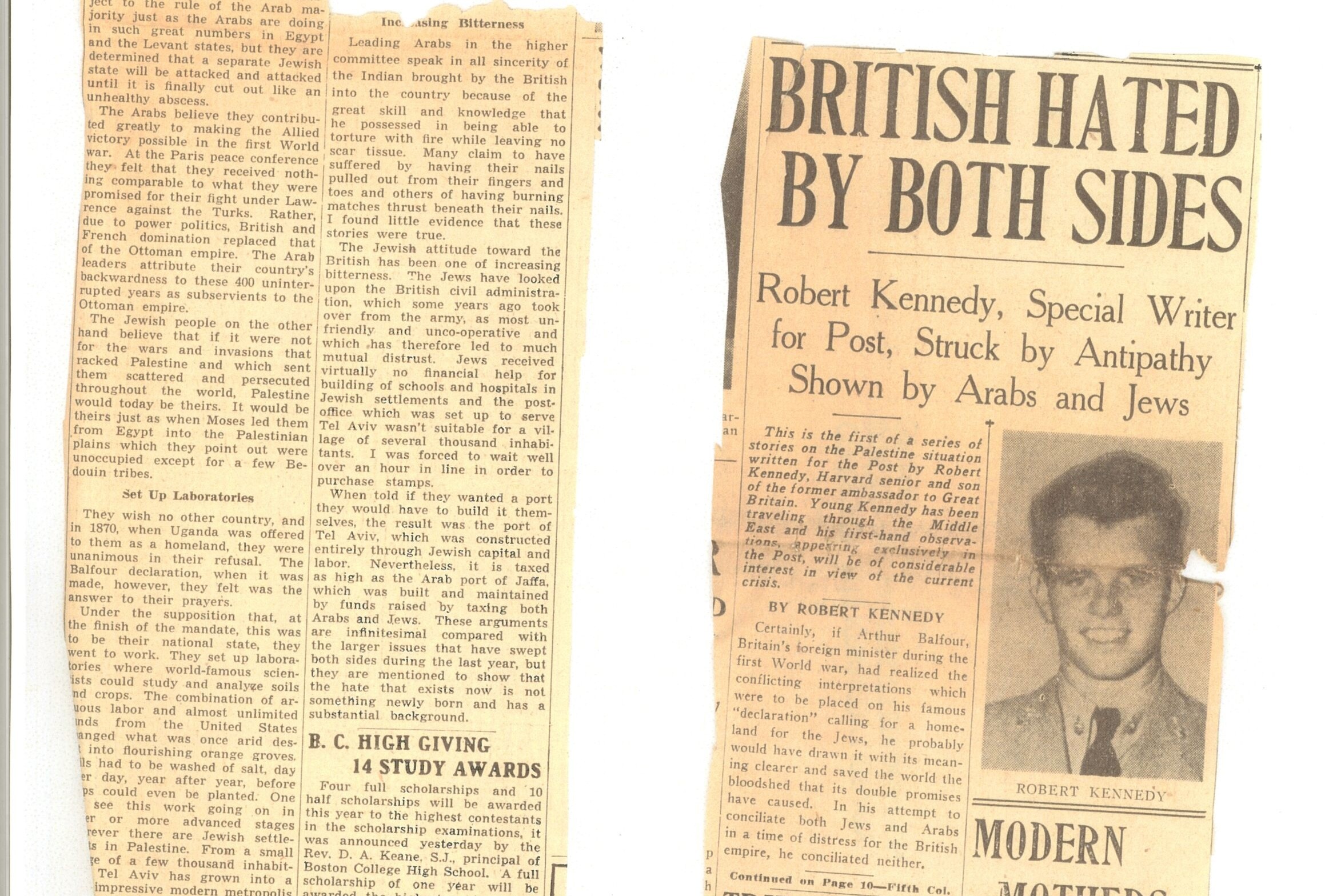
This is the first of a series of stories on the Palestine situation written for the Post by Robert Kennedy, Harvard senior and son of the former ambassador to Great Britain. Young Kennedy has been traveling through the Middle East and his first-hand observations, appearing exclusively in the Post, will be of considerable interest in view of the current crisis.
BY ROBERT KENNEDY
Certainly, if Arthur Balfour, Britain’s foreign minister during the first World War, had realized the conflicting interpretations which were to be placed on his famous “declaration” calling for a homeland for the Jews, he probably would have drawn it with its meaning clearer and saved the world the bloodshed that its double promises have caused. In his attempt to conciliate both Jews and Arabs in a time of distress for the British Empire, he conciliated neither.
Always Will Attack
They are willing to let the Jews remain as peaceful citizens subject to the rule of the Arab majority just as the Arabs are doing in such great numbers in Egypt and the Levant states, but they are determined that a separate Jewish state will be attacked and attacked until it is finally cut out like an unhealthy abscess.
The Arabs believe they contributed greatly to making the Allied victory possible in the first World War. At the Paris Peace Conference they felt that they received nothing comparable to what they were promised for their fight under Lawrence against the Turks. Rather, due to power politics, British and French domination replaced that of the Ottoman Empire. The Arab leaders attribute their country’s backwardness to these 400 uninterrupted years as subservients to the Ottoman Empire.
The Jewish people, on the other hand, believe that if it were not for the wars and invasions that racked Palestine and which sent them scattered and persecuted throughout the world, Palestine would today be theirs. It would be theirs just as when Moses led them from Egypt into the Palestinian plains which they point out were unoccupied except for a few Bedouin tribes.
Set Up Laboratories
They wish no other country, and in 1870, when Uganda was offered to them as a homeland, they were unanimous in their refusal. The Balfour Declaration, when it was made, however, they felt was the answer to their prayers.
Under the supposition that, at the finish of the mandate, this was to be their national state, they went to work. They set up laboratories where world-famous scientists could study and analyze soils and crops. The combination of arduous labor and almost unlimited funds from the United States changed what was once arid desert into flourishing orange groves. Soils had to be washed of salt, day after day, year after year, before crops could even be planted.
One can see this work going on in two or more advanced stages wherever there are Jewish settlements in Palestine. From a small state of a few thousand inhabitants Tel Aviv has grown into an impressive modern metropolis of over 200,000. They have truly done much with what all agree is very little.
Jews point with pride to the fact that over 500,000 Arabs, in the years between 1932–1944, came to Palestine to take advantage of conditions existing in no Arab state. This is the only place in the Near and Middle East where an Arab middle class is in existence.
Jews point out that they have always taken a passive part in the frequent revolutions that rocked the country, because of the understanding that they would eventually be set free from the Mandateship.
Increasing Bitterness
Leading Arabs in the higher committee speak in all sincerity of the Indian brought by the British into the country because of the great skill and knowledge that he possessed in being able to torture with fire while leaving no scar tissue. Many claim to have suffered by having their nails pulled out from their fingers and toes and others of having burning matches thrust beneath their nails. I found little evidence that these stories were true.
The Jewish attitude toward the British has been one of increasing bitterness. The Jews have looked upon the British civil administration, which some years ago took over from the army, as most unfriendly and unco-operative and which has therefore led to much mutual distrust.
Jews received virtually no financial help for building of schools and hospitals in Jewish settlements and the post office which was set up to serve Tel Aviv wasn’t suitable for a village of several thousand inhabitants. I was forced to wait well over an hour in line in order to purchase stamps.
When told if they wanted a port they would have to build it themselves, the result was the port of Tel Aviv, which was constructed entirely through Jewish capital and labor. Nevertheless, it is taxed as high as the Arab port of Jaffa, which was built and maintained by funds raised by taxing both Arabs and Jews.
These arguments are infinitesimal compared with the larger issues that have swept both sides during the last year, but they are mentioned to show that the hate that exists now is not something newly born and has a substantial background.
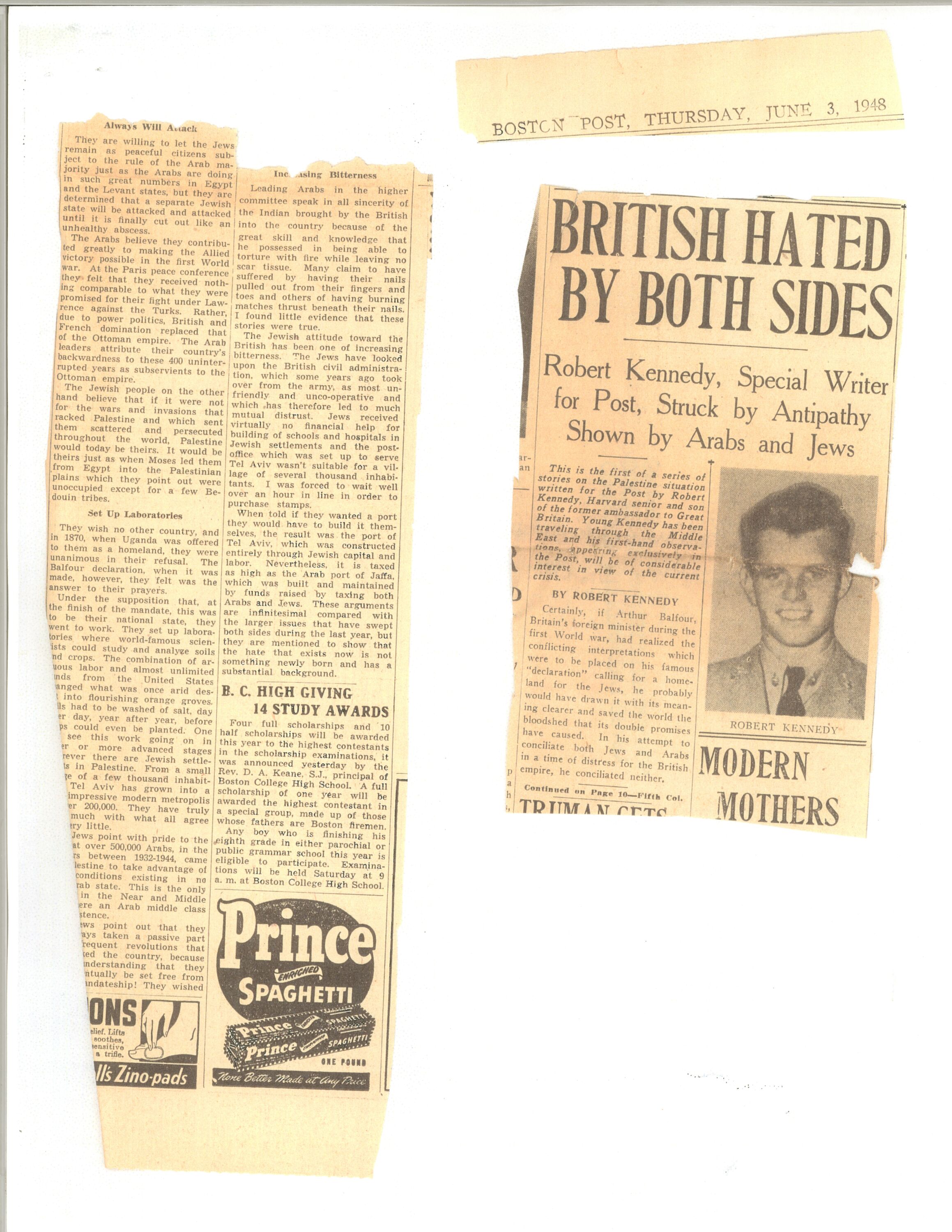
June 03, 1948 | © The Boston Globe
Archival material reproduced here for educational and research purposes under fair use. Original copyright belongs to the respective publisher.
About

Every headline has a history. We go back to the archives of the same media you read today — to show how their own words have changed. Facts don’t expire. Narratives do.
Featured Posts




Related Post

The Boston Globe

The Boston Globe
The Boston Globe