Nov 1, 1930
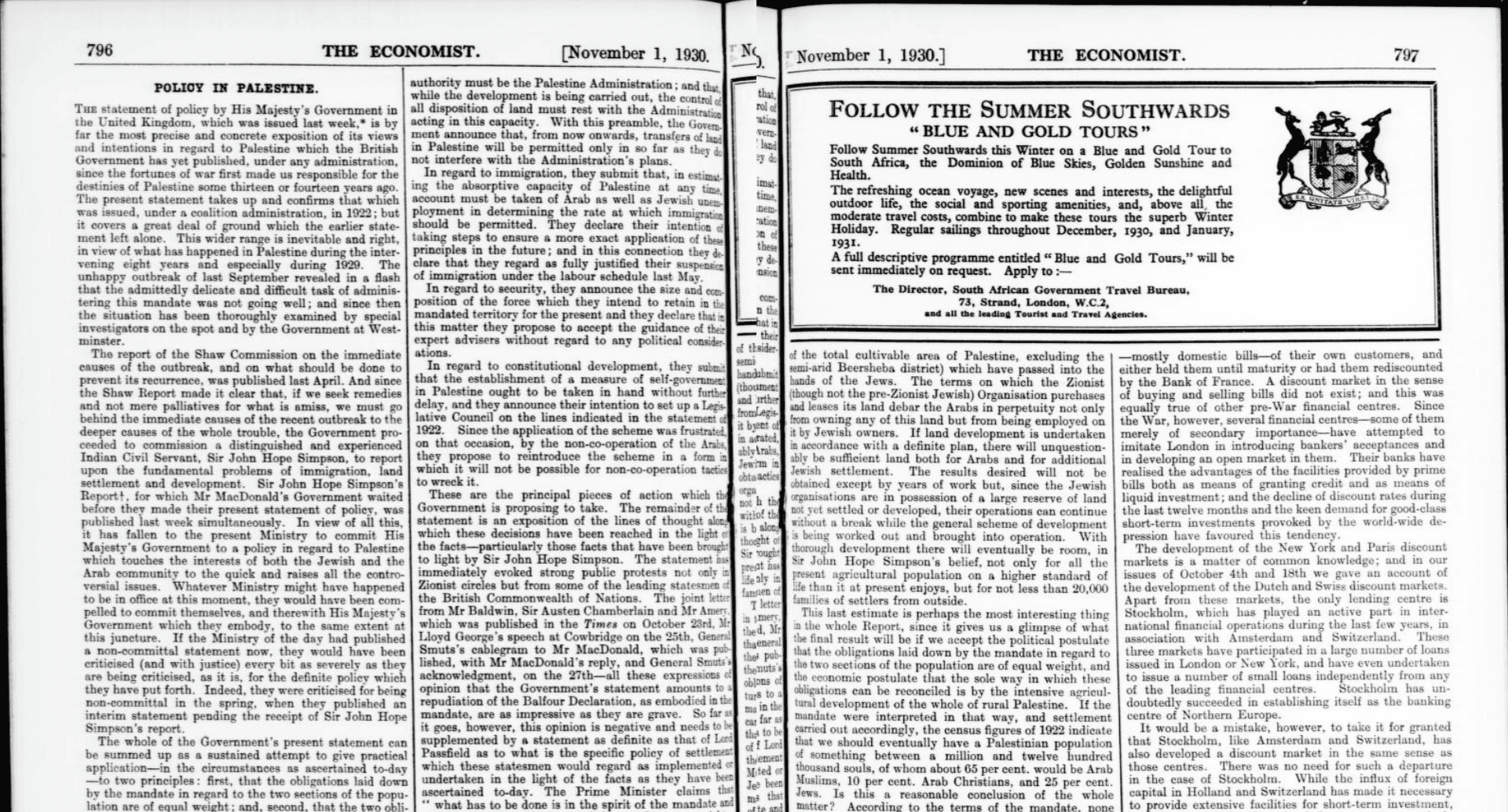
THE statement of policy by His Majesty’s Government in the United Kingdom, which was issued last week,* is by far the most precise and concrete exposition of its views and intentions in regard to Palestine which the British Government has yet published, under any administration, since the fortunes of war first made us responsible for the destinies of Palestine some thirteen or fourteen years ago. The present statement takes up and confirms that which was issued, under a coalition administration, in 1922; but it covers a great deal of ground which the earlier statement left alone. This wider range is inevitable and right, in view of what has happened in Palestine during the intervening eight years and especially during 1929. The unhappy outbreak of last September revealed in a flash that the admittedly delicate and difficult task of administering this mandate was not going well; and since then the situation has been thoroughly examined by special investigators on the spot and by the Government at Westminster.
The report of the Shaw Commission on the immediate causes of the outbreak, and on what should be done to prevent its recurrence, was published last April. And since the Shaw Report made it clear that, if we seek remedies and not mere palliatives for what is amiss, we must go behind the immediate causes of the recent outbreak to the deeper causes of the whole trouble, the Government proceeded to commission a distinguished and experienced Indian Civil Servant, Sir John Hope Simpson, to report upon the fundamental problems of immigration, land settlement and development. Sir John Hope Simpson’s Report†, for which Mr MacDonald’s Government waited before they made their present statement of policy, was published last week simultaneously. In view of all this, it has fallen to the present Ministry to commit His Majesty’s Government to a policy in regard to Palestine which touches the interests of both the Jewish and the Arab community to the quick and raises all the controversial issues. Whatever Ministry might have happened to be in office at this moment, they would have been compelled to commit themselves, and therewith His Majesty’s Government which they embody, to the same extent at this juncture. If the Ministry of the day had published a non-committal statement now, they would have been criticised (and with justice) every bit as severely as they are being criticised, as it is, for the definite policy which they have put forth. Indeed, they were criticised for being non-committal in the spring, when they published an interim statement pending the receipt of Sir John Hope Simpson’s report.
The whole of the Government’s present statement can be summed up as a sustained attempt to give practical application—in the circumstances as ascertained to-day—to two principles: first, that the obligations laid down by the mandate in regard to the two sections of the population are of equal weight; and, second, that the two obligations imposed on the mandatory are in no sense irreconcilable. These were the terms in which the Permanent Mandates Commission of the League of Nations summed up last June what it understood to be the British Government’s attitude. The Commission has declared that, in its own view, these terms accurately express what it conceives to be the essence of the Mandate for Palestine. In its statement the British Government accepts the Permanent Mandates Commission’s formulation of British policy, and the White Paper represents a systematic effort to draw the consequences which follow from these two propositions taken together. It is not fair to a State paper of this kind to give a précis of it. Every sentence counts, and whoever wishes to pass judgment upon it must do it the justice of reading it in the original. We will confine ourselves here to noticing the various pieces of definite action which the Government announce their intention to take.
In regard to agricultural development, they submit that a more methodical agricultural development of the whole country is called for; that there must be a single authority in charge of this development; that this authority must be the Palestine Administration; and that, while the development is being carried out, the control of all disposition of land must rest with the Administration acting in this capacity. With this preamble, the Government announce that, from now onwards, transfers of land in Palestine will be permitted only in so far as they do not interfere with the Administration’s plans.
In regard to immigration, they submit that, in estimating the absorptive capacity of Palestine at any time, account must be taken of Arab as well as Jewish unemployment in determining the rate at which immigration should be permitted. They declare their intention of taking steps to ensure a more exact application of these principles in the future; and in this connection they declare that they regard as fully justified their suspension of immigration under the labour schedule last May.
In regard to security, they announce the size and composition of the force which they intend to retain in the mandated territory for the present and they declare that in this matter they propose to accept the guidance of their expert advisers without regard to any political considerations.
In regard to constitutional development, they submit that the establishment of a measure of self-government in Palestine ought to be taken in hand without further delay, and they announce their intention to set up a Legislative Council on the lines indicated in the statement of 1922. Since the application of the scheme was frustrated, on that occasion, by the non-co-operation of the Arabs, they propose to reintroduce the scheme in a form in which it will not be possible for non-co-operation tactics to wreck it.
These are the principal pieces of action which the Government is proposing to take. The remainder of the statement is an exposition of the lines of thought along which these decisions have been reached in the light of the facts—particularly those facts that have been brought to light by Sir John Hope Simpson. The statement has immediately evoked strong public protests not only in Zionist circles but from some of the leading statesmen of the British Commonwealth of Nations. The joint letter from Mr Baldwin, Sir Austen Chamberlain and Mr Amery, which was published in the Times on October 23rd, Mr Lloyd George’s speech at Cowbridge on the 25th, General Smuts’s cablegram to Mr MacDonald, which was published, with Mr MacDonald’s reply, and General Smuts’s acknowledgment, on the 27th—all these expressions of opinion that the Government’s statement amounts to a repudiation of the Balfour Declaration, as embodied in the mandate, are as impressive as they are grave. So far as it goes, however, this opinion is negative and needs to be supplemented by a statement as definite as that of Lord Passfield as to what is the specific policy of settlement which these statesmen would regard as implemented or undertaken in the light of the facts as they have been ascertained to-day. The Prime Minister claims that “what has to be done is in the spirit of the mandate and sticking strictly to the letter of the mandate, to straighten out the differences between the contradictory parts of certain declarations.” It is incumbent on those who criticise the Government’s interpretation to show that there is an alternative practical policy which is consistent with all of our undertakings. In the meantime all that we can do is to call attention to one or two of the facts which Sir John Hope Simpson has brought to light for the first time.
Sir John Hope Simpson has ascertained “quite definitely” that there is at the present time, and with the present methods of Arab cultivation, no margin of land available for agricultural settlement by new immigrants with the exception of such undeveloped land as the various Jewish Agencies hold in reserve. While an area of at least 130 “dunums” is required in order to maintain an Arab peasant family in a decent standard of life in the unirrigated tracts, the whole of the cultivable land not already in the hands of the Jews would not afford an average lot in excess of 90 “dunums,” were it divided among the existing Arab cultivators. The Arab population has increased with great rapidity, and the land available for its sustenance has meanwhile decreased by about a million metric “dunums” (that is, 60 or 70 per cent of the total cultivable area of Palestine, excluding the semi-arid Beersheba district) which have passed into the hands of the Jews. The terms on which the Zionist (though not the pre-Zionist Jewish) Organisation purchases and leases its land debar the Arabs in perpetuity not only from owning any of this land but from being employed on it by Jewish owners. If land development is undertaken in accordance with a definite plan, there will unquestionably be sufficient land both for Arabs and for additional Jewish settlement. The results desired will not be obtained except by years of work but, since the Jewish organisations are in possession of a large reserve of land not yet settled or developed, their operations can continue without a break while the general scheme of development is being worked out and brought into operation. With thorough development there will eventually be room, in Sir John Hope Simpson’s belief, not only for all the present agricultural population on a higher standard of life than it at present enjoys, but for not less than 20,000 families of settlers from outside.
This last estimate is perhaps the most interesting thing in the whole Report, since it gives us a glimpse of what the final result will be if we accept the political postulate that the obligations laid down by the mandate in regard to the two sections of the population are of equal weight, and the economic postulate that the sole way in which these obligations can be reconciled is by the intensive agricultural development of the whole of rural Palestine. If the mandate were interpreted in that way, and settlement carried out accordingly, the census figures of 1922 indicate that we should eventually have a Palestinian population of something between a million and twelve hundred thousand souls, of whom about 65 per cent. would be Arab Muslims, 10 per cent. Arab Christians, and 25 per cent. Jews. Is this a reasonable conclusion of the whole matter? According to the terms of the mandate, none of these communities would have lesser or greater rights in the country than any other. Would these communities be willing or able to co-operate in governing their common national home for themselves when the mandate terminates? The term at which the mandate must give place to full self-government is set already by the political environment. Of Palestine’s neighbours, the Najda-Hijaz is fully self-governing to-day; Egypt and Iraq will be fully self-governing to-morrow, and Transjordan, Syria and the Lebanon the day after. It will require the highest qualities of statesmanship to fit Palestine, with its dual character, into this setting of self-governing Arab states.
November 1, 1930 | © The Economist
Archival material reproduced here for educational and research purposes under fair use. Original copyright belongs to the respective publisher.
About

Every headline has a history. We go back to the archives of the same media you read today — to show how their own words have changed. Facts don’t expire. Narratives do.
Featured Posts





Related Post
The Economist
The Economist