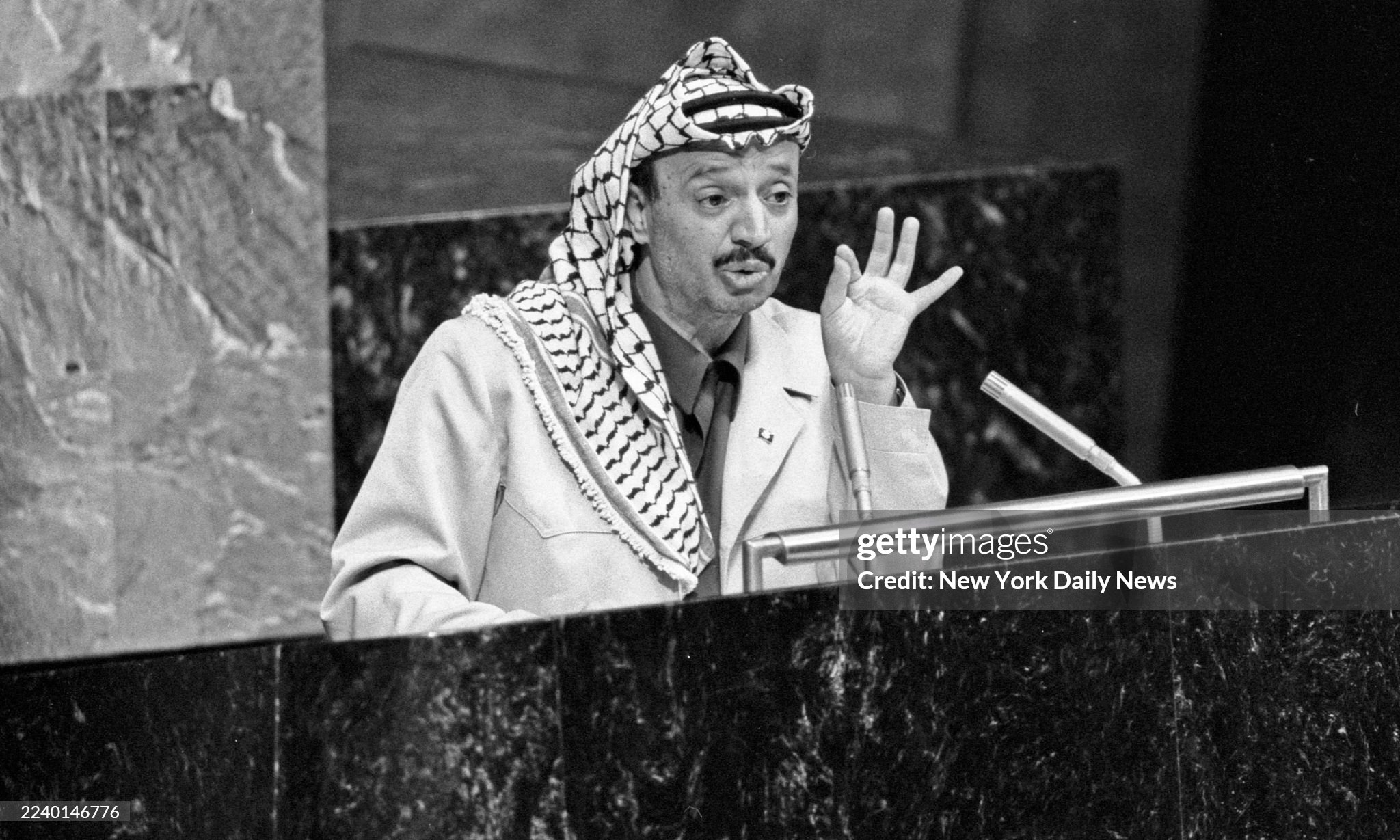
Oct 26, 1985
During the past few weeks, the world watched in horror and anger as Yasser Arafat acted to disprove his own assertion that the PLO sought a peaceful settlement of the Arab-Israeli conflict.
Millions of spectators in the global village saw the corpse of a 50-year-old Israeli woman draped across the railing of a boat in the harbor of Larnaca, Cyprus, and saw below-deck the bodies of two Israeli men who had been shot in the head with their hands tied behind their backs. Days later came the unforgettable face of Leon Klinghoffer’s widow, frozen in grief and fear.
Contemplating those images, men and women of conscience cursed the leader who could send his commandos to commit such heartless and arbitrary crimes. The spectators observed Arafat’s work, listened to his threadbare lies, and forgot about the plight of the Palestinian people.
Even if Arafat is not directly responsible for every atrocity carried out by PLO forces, his transparent dishonesty in trying to cover them up has made it harder than ever for friends in the Arab world to include him in a Mideast peace process.
His lame efforts to explain away atrocities made it easier for his enemies in the region to argue that he must not be acknowledged as the leader of the Palestinian people. Above all, his actions have hurt Palestinians who long for a flag, a passport and a homeland they can call their own.
In the first hours of the Achille Lauro crisis, Arafat appeared on ABC's "Nightline" to tell Ted Koppel that he had nothing to do with the pirates, that he renounced terrorism of this kind.
The man who commands an organization that professes to be the "sole legitimate representative of the Palestinian people" stared into the camera and asserted that the terrorists on the Italian cruise ship were elements acting "out of control." He compared them to groups such as the Italian Red Brigades, the Japanese Red Army or the West German Baader-Meinhof gang, insisting that he had no more authority over the Achille Lauro pirates than European governments had over those terrorist organizations.
The analogy was particularly cynical because Arafat in the past has maintained operational connections with each of the terrorist bands he mentioned.
His denial of responsibility was revealed as a lie when the Palestine Liberation Front, the PLO faction under his close friend and supporter Mohammed Abbas, declared that it had dispatched the hijackers on a terrorist mission inside Israel. The lies Arafat and Abbas later fabricated about Klinghoffer’s having a heart attack and disappearing demonstrated their mendacity and stupidity.
Just as King Hussein and Hosni Mubarak were assuring officials and Jewish organizations in the US that Arafat had transformed himself into a peace-seeking moderate, his renewed terrorism, compounded by the lies, achieved the aims of his adversaries and alienated his would-be allies.
Confirming the truism that politics makes strange bedfellows, Shimon Peres and Syrian dictator Hafez Assad took equal delight in the spectacle of Arafat's disqualifying himself from participation in the Hussein peace initiative.
Syria’s police state demonstrated Assad’s eagerness to expose Arafat as a fool and a liar when it informed America that Klinghoffer's body had washed ashore in Syria. The Syrians could have disposed of the body in silence, but chose to offer US authorities uncharacteristic cooperation, thereby catching Arafat in his lie.
Assad does not want a negotiated settlement now between Israel and a Jordanian-Palestinian team. Moreover, he wants to discredit or eliminate his longtime enemy, Arafat. The PLO leader, by his own actions, helped Assad approach both these goals.
At the same time, a PLO representative scotched a momentous meeting with Britain’s foreign secretary when he refused at the last minute to sign a pledge saying the PLO was prepared to recognize Israel's right to exist. Arafat's initial excuse for the refusal was a contention that the British had treacherously altered the text to be signed.
Hussein, showing his exasperation with Arafat, appeared on British TV to say that he, the PLO and the British had agreed beforehand to the wording of the pledge, and that London had acted "honorably."
Once again, Arafat has failed to board the peace train. He has acted to perpetuate his own power while his people languish as stateless refugees or subjects of an occupying power.
History may decide that he was victimized by Assad's ruthless plan to divide and rule the Palestinian movement. Whatever the cause for Arafat's failure, he has left the Palestinian people with less hope than ever of saving their land, determining their own fate, or bequeathing their children a better future.
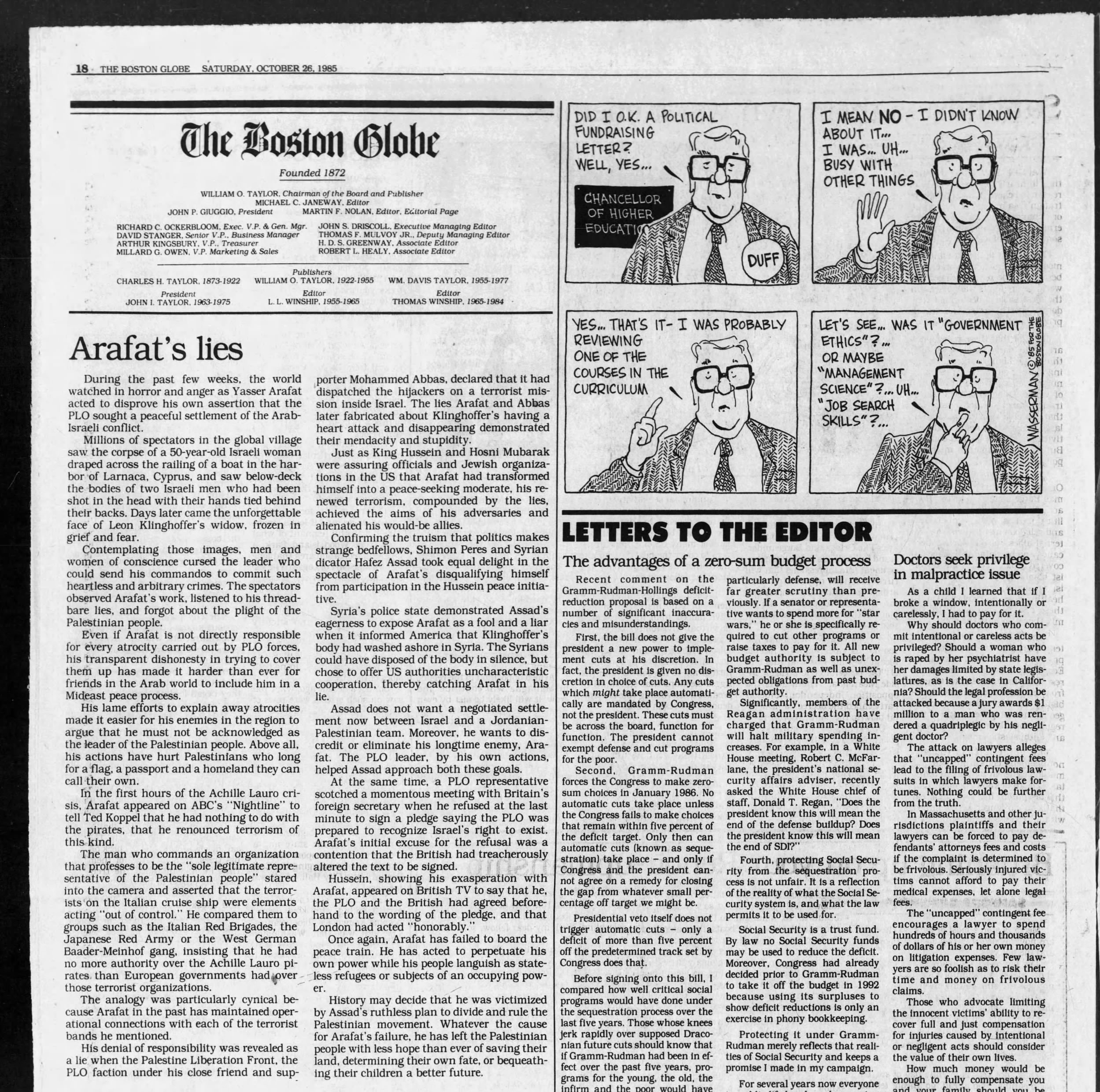
October 26, 1985 | © The Boston Globe
Archival material reproduced here for educational and research purposes under fair use. Original copyright belongs to the respective publisher.
About

Every headline has a history. We go back to the archives of the same media you read today — to show how their own words have changed. Facts don’t expire. Narratives do.
Featured Posts





Related Post

The Boston Globe
The Boston Globe
The Boston Globe