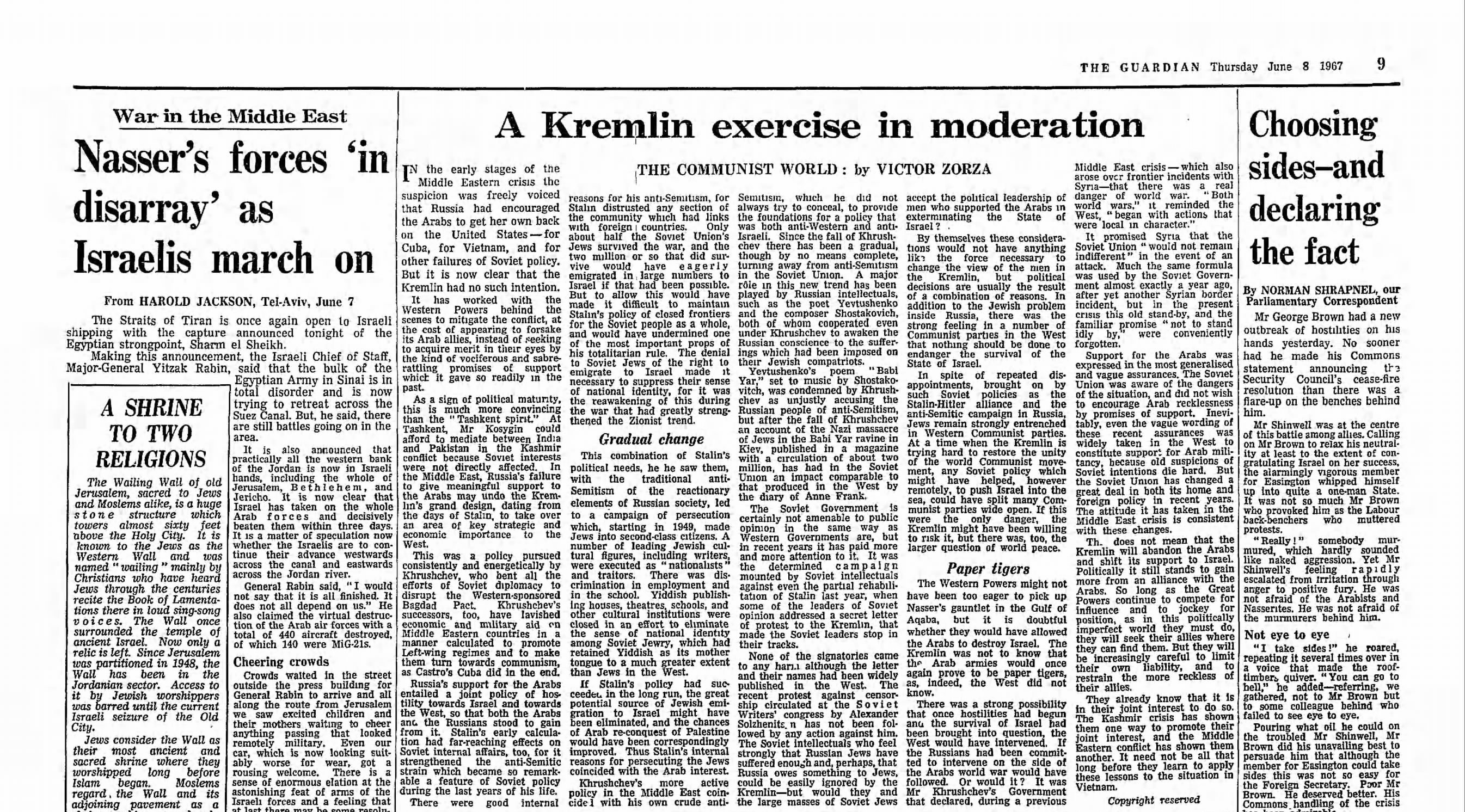
A Kremlin exercise in moderation
THE COMMUNIST WORLD: by VICTOR ZORZA
Jun 8, 1967
IN the early stages of the Middle Eastern crisis the suspicion was freely voiced that Russia had encouraged the Arabs to get her own back on the United States - for Cuba, for Vietnam, and for other failures of Soviet policy. But it is now clear that the Kremlin had no such intention.
It has worked with the Western Powers behind the scenes to mitigate the conflict, at the cost of appearing to forsake its Arab allies, instead of seeking to acquire merit in their eyes by the kind of vociferous and sabrerattling promises of support which it gave so readily in the past.
As a sign of political maturity, this is much more convincing than the "Tashkent spirit." At Tashkent, Mr Kosygin could afford to mediate between India and Pakistan in the Kashmir conflict because Soviet interests were not directly affected. In the Middle East, Russia's failure to give meaningful support to the Arabs may undo the Kremlin's grand design, dating from the days of Stalin, to take over an area of key strategic and economic importance to the West.
This was a policy pursued consistently and energetically by Khrushchev, who bent all the efforts of Soviet diplomacy to disrupt the western-sponsored Bagdad Pact. Khrushchev's successors, too, have lavished economic and military aid on Middle Eastern countries in a manner calculated to promote Left-wing regimes and to make them turn towards communism, as Castro's Cuba did in the end.
Russia's support for the Arabs entailed a joint policy of hostility towards Israel and towards the West, so that both the Arabs and the Russians stood to gain from it. Rolling early calculations held far-reaching effects on Soviet internal affairs, too, for it strengthened the anti-Semitic strain which became so remark able a feature of Soviet policy during the last years of his life.
There were good internal reasons for his anti-Semitism, for that community which had links with foreign countries. Only about half the Soviet Union's Jews survived the war, and the two million or so that did survive would have eagerly emigrated to large numbers to Israel if that had been possible. But to allow this would have made it difficult to maintain Stalin's policy of closed frontiers for the Soviet people as a whole and would have undermined one of the most important props of his totalitarian rule. The denial to Soviet Jews of the right to emigrate to Israel made it necessary to suppress their sense of national identity, for it was the reawakening of that during the war that had greatly strengthened the Zionist trend.
Gradual change
This combination of Stalin's political needs, he saw them, with the traditional anti-Semitism of the reactionary elements of Russian society, led to a campaign of persecution which, starting in 1948, made Jews into second-class citizens. A number of leading Jewish cultural figures, including writers, were executed as "nationalists" and traitors. There was discrimination in employment and in the school. Yiddish publishing, houses, theatres, schools, and other cultural institutions were closed in an effort to eliminate the sense of national identity among Soviet Jews, which had regained Yiddish as its mother tongue to a much greater extent than Jews in the West.
If Stalin's policy had succeeded, in the long run the great potential source of Jewish emigration to Israel might have been eliminated and the chances of Arab re-conquest of Palestine would have been correspondingly improved. Thus Stalin's internal reasons for persecuting the Jews coincided with the Arab interest.
Khrushchev's more active policy in the Middle East coincide with his own crude anti-Semitism, which he did not always try to conceal, to provide the foundation for a policy that was both anti-Western and anti-Israeli. Since the fall of Khrushchev there has been a gradual, though by no means complete turning away from anti-Semitism in the Soviet Union. A major role in this new trend has been played by Russian intellectuals such as the poet Yevtushenko and the composer Shostakovich, both of whom cooperated even under Khrushchev to weaken the Russian conscience to the sufferings which had been imposed on their Jewish compatriots.
Yevtushenko's poem "Babi Yar," set to music by Shostakovich, was condemned by Khrushchev as unjustly accusing the Russian people of anti-Semitism. But after the fall of Khrushchev an account of the Nazi massacre of Jews in the Babi Yar ravine in Kiev, published in a magazine with a circulation of about two million, has had in the Soviet Union an impact comparable to that produced in the West by the diary of Anne Frank.
The Soviet Government is certainly not amenable to public opinion in the same way as Western Governments, and but in recent years it has paid more and more attention to it. It was the determined campaign against anti-Soviet intellectuals, even against the partial rehabilitation of Stalin last year, when some of the leaders of Soviet opinion addressed a secret letter of protest to the Kremlin, that made the Soviet leaders stop in their tracks.
None of the signatories came to any harm, although the letter and their names had been widely published in the West. The recent protest against censors ship, circulated to the Soviet Writers' congress by Alexander Solzhenitsin, has not been followed by any action against him. The Soviet intellectuals who feel strongly that Russian Jews have suffered enough and, perhaps, that Russia owes something to Jewry, would be easily ignored by the Kremlin-but would they and the large masses of Soviet Jews men who supported the Arabs in exterminating the State of Israel?
By themselves these considerations would not have anything like the force necessary to change the view of the men in the Kremlin; but political decisions are usually the result of a combination of reasons. In addition to the Jewish problem inside Russia, there was the strong feeling in a number of Communist parties in the West that nothing should be done to endanger the survival of the State of Israel.
In spite of repeated dis appointments brought on by such Soviet policies as the Stalin-Hitler alliance and the anti-Semitic campaign in Russia, Jews remain strongly entrenched in Western Communist parties. At a time when the Kremlin is trying hard to restore the unity of the world Communist move ment, any Soviet policy which might have helped, however remotely, to push Israel into the sea, could have split many Communist parties wide open. If this were the only danger, the Kremlin might have been willing to risk it, but there are too, the larger question of world peace.
Paper tigers
The Western Powers might not have been too eager in the gulf of Nasser's gauntlet in the Gulf of Aqaba, but it is doubtful whether they will have allowed the Arabs to destroy Israel. The Kremlin was not to know that the Arab armies would once again prove to be paper tigers, as indeed, the West did not know.
There was a strong possibility that once hostilities had begun and the survival of Israel had been brought into question, the West would have intervened. If the Russians had been committed to intervene on the side of the Arabs world war would have followed. Or would it? It was Mr Khrushchev's Government that declared, during a previous Middle East crisis - which also arose over frontier incidents with Syria - that there was a "real danger of world war," it reminded the west, "began with actions that were local in character."
It promised Syria that the Soviet Union "would not remain indifferent" in the event of an attack. Much the same formula was used by the Soviet Government almost exactly a year ago, after yet another Syrian border incident, but in the present crisis this old stand-by, and the familiar promise "not to stand idly by," were conveniently forgotten.
Support for the Arabs was expressed in the most generalised and vague assurances. The Soviet Union was aware of the dangers of the situation, and did not wish to encourage Arab recklessness by promises of support. Inevitably, even the vague wording of these recent assurances was widely taken in the West to constitute support for Arab militancy, because old suspicions of Soviet intentions die hard. But the Soviet Union has changed a great deal in both its home and foreign policy in recent years; and the attitude it has taken in the Middle East crisis is consistent with these changes.
That does not mean that the Kremlin will abandon the Arabs and shift its support to Israel. Politically it still stands to gain more from an alliance with the Arabs. So long as the Great Powers continue to compete for influence and to jockey for position, and in this politically imperfect world they must do, they will seek their allies where they can find them. But they will be increasingly careful to limit their own liability, and to restrain the more reckless of their allies.
They already know that it is in their joint interest to do so. The Kashmir crisis has shown them one way to promote their joint interest, and the Middle Eastern conflict has shown them another. It need not be all that long before they learn to apply these lessons to the situation in Vietnam.
Copyright reserved.
June 8, 1967 | © The Guardian
Archival material reproduced here for educational and research purposes under fair use. Original copyright belongs to the respective publisher.
About

Every headline has a history. We go back to the archives of the same media you read today — to show how their own words have changed. Facts don’t expire. Narratives do.
Featured Posts