Jun 2, 1936
To the Editor of the Manchester Guardian
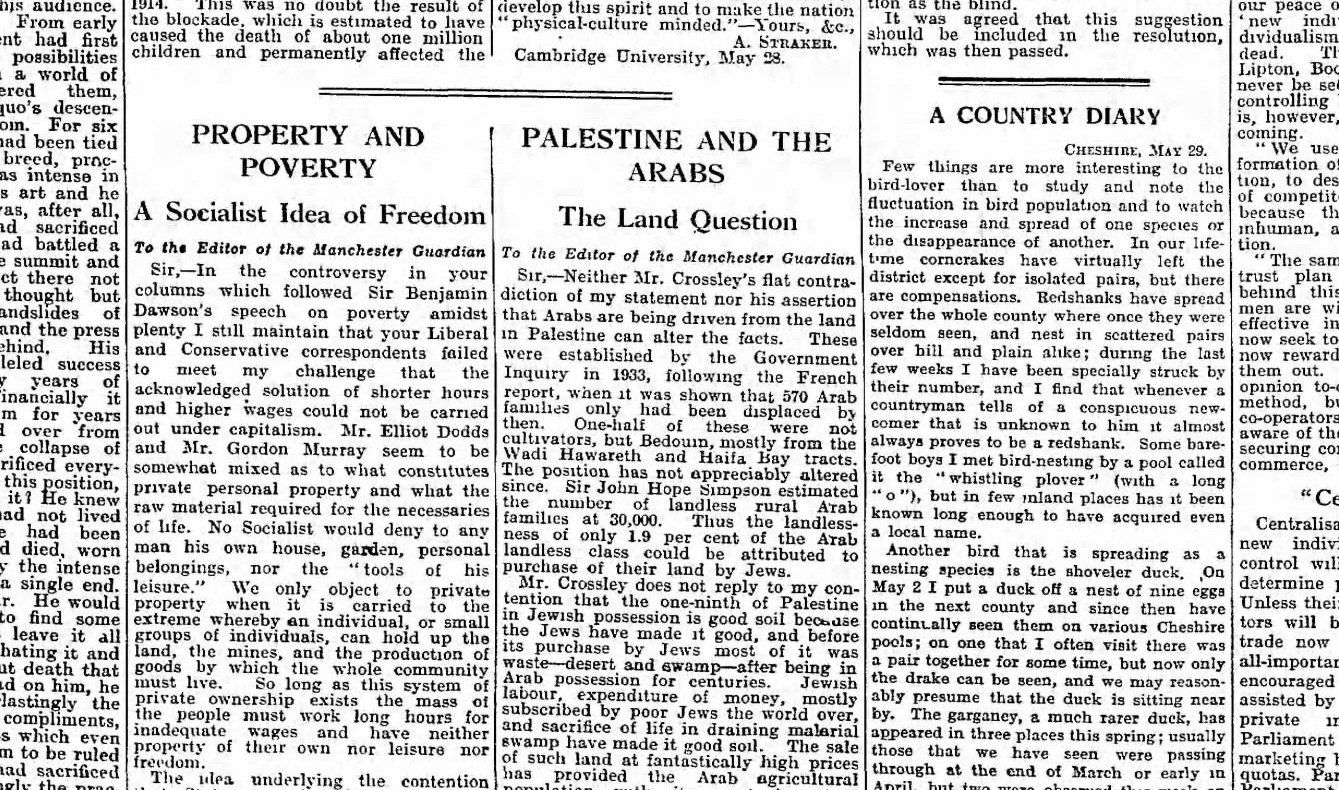
Sir,—Neither Mr. Crossley’s flat contradiction of my statement nor his assertion that Arabs are being driven from the land in Palestine can alter the facts. These were established by the Government Inquiry in 1933, following the French report, when it was shown that 570 Arab families only had been displaced by then. One-half of these were not cultivators, but Bedouin, mostly from Wadi Hawareth and Haifa Bay tracts. The position has not appreciably altered since. Sir John Hope Simpson estimated the number of landless rural Arab families at 30,000. Thus the landlessness of only 1.9 per cent of the Arab landless class could be attributed to purchase of their land by Jews.
Mr. Crossley does not reply to my contention that the one-ninth of Palestine in Jewish possession is good soil because its purchase by Jews, most of it was waste—desert and swamp—after being in Arab possession for centuries. Jewish labour, expenditure of money, mostly subscribed by poor Jews the world over, and sacrifice of life in draining malarial swamp have made it good soil.
The sale of such land at fantastically high prices has provided the Arab agricultural population with its most important source of capital for development. To take Wadi Hawareth as an example: where two hundred Arab families formerly lived in destitution an additional 1,500 Jewish families are now being settled on the land and live with European standards, while another 3,000 families with varied occupations (workers, artisans, teachers, &c.) will be settled in the same area. Every area of Jewish settlement will show similar facts.
It cannot be denied that the growth of the non-Jewish population has been most marked in precisely those areas which are closest to the districts of Jewish development.
There still remains much land, “rock and hill, shrub and desert,” which needs an opportunity to acquire in part, and will transform into good soil, and the Arab peasant which will supply such Arabs by means to develop their good soil and to live under altogether better conditions than at present. The case of Huleh concession, where the provision of land for Jewish settlement is bound up with the improvement of the position of local Arab agriculturists, is an example of what can be done in the rest of Palestine.
The position of Arab cultivators in the past has been such that they have been unable to maintain a decent standard of life. Having no capital, they have been heavily in debt to the Arab landowners and moneylenders, have paid extortionate rates of interest, and have indeed been in the position of “hewers of wood and drawers of water” to the Effendi class—the class which, fearing it will no longer be in a position to exploit the peasants, is inciting them against Jewish immigration, British rule, and European ideas.
I found the views of English residents and officials in Palestine to be not so simple, categorical, or unanimous as Mr. Crossley infers. It was pointed out that the results of Jewish achievement had different effects on the Effendi class, the Arab masses, and the Bedouin. The position of influence of the Effendi class is being undermined, that of the Arab masses improved in every way, while the Bedouin were having to alter their mode of life. The Times special correspondent recently wrote of “the attraction exercised by the Palestinian fellah” and still more by “the picturesque but destructive Bedu upon the products of English schools and colleges.” In spite of which I know English residents of Palestine who are in sympathy with Jewish aspirations.
—Yours, &c.,
Simon Kelly
22, St. John Street, Manchester, May 31.
June 2, 1936 | © The Guardian
Archival material reproduced here for educational and research purposes under fair use. Original copyright belongs to the respective publisher.
About

Every headline has a history. We go back to the archives of the same media you read today — to show how their own words have changed. Facts don’t expire. Narratives do.
Featured Posts