IMPORTANT INTELLIGENCE FROM PALESTINE.
(From the Plymouth Herald.)
Dec 6, 1834
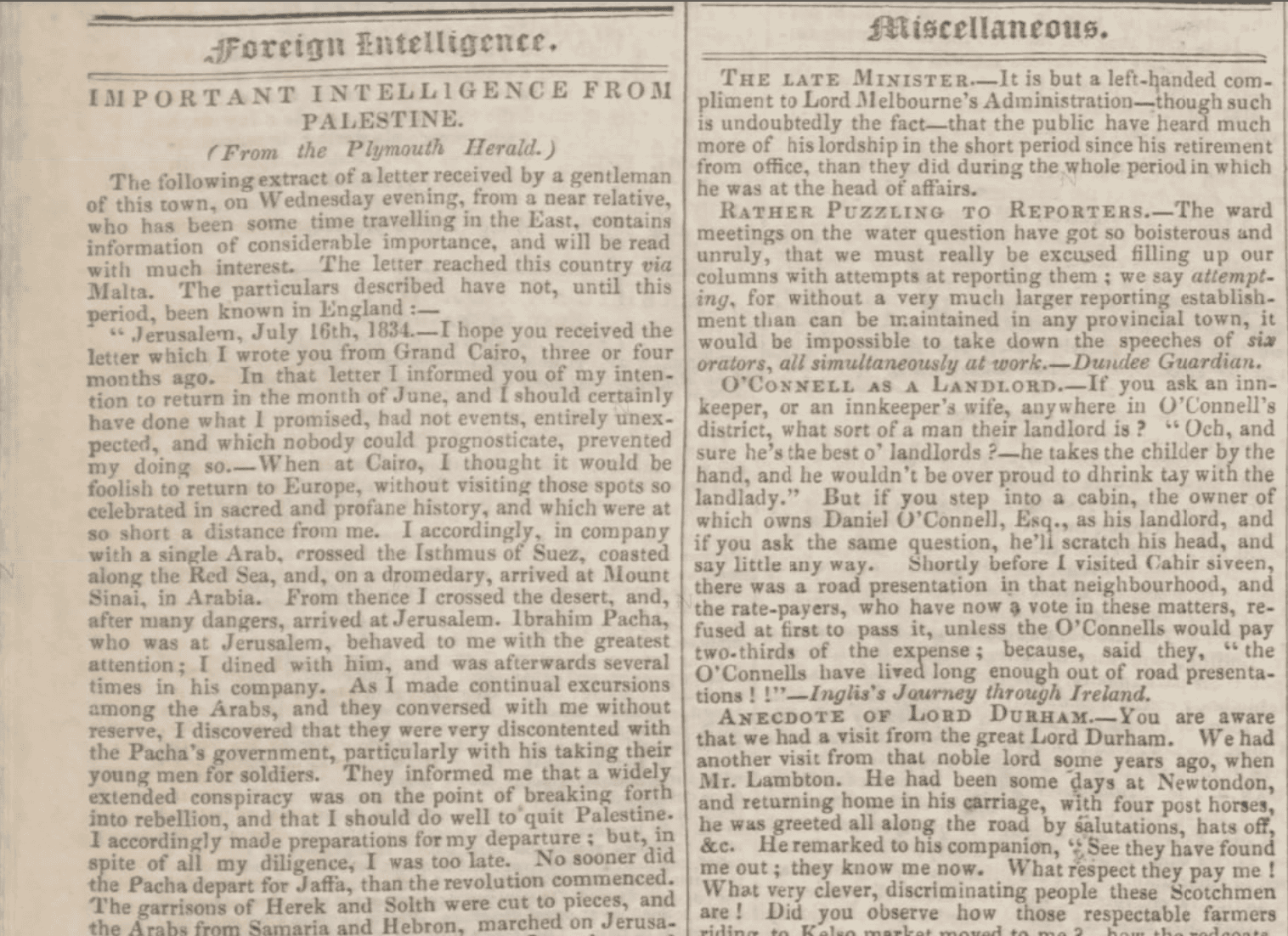
The following extract of a letter received by a gentleman of this town, on Wednesday evening, from a near relative, who has been some time travelling in the East, contains information of considerable importance, and will be read with much interest. The letter reached this country via Malta. The particulars described have not, until this period, been known in England :—
“Jerusalem, July 16th, 1834.—I hope you received the letter which I wrote you from Grand Cairo, three or four months ago. In that letter I informed you of my intention to return in the month of June, and I should certainly have done what I promised, had not events, entirely unexpected, and which nobody could prognosticate, prevented my doing so.—When at Cairo, I thought it would be foolish to return to Europe, without visiting those spots so celebrated in sacred and profane history, and which were at so short a distance from me. I accordingly, in company with a single Arab, crossed the Isthmus of Suez, coasted along the Red Sea, and, on a dromedary, arrived at Mount Sinai, in Arabia. From thence I crossed the desert, and, after many dangers, arrived at Jerusalem. Ibrahim Pacha, who was at Jerusalem, behaved to me with the greatest attention; I dined with him, and was afterwards several times in his company. As I made continual excursions among the Arabs, and they conversed with me without reserve, I discovered that they were very discontented with the Pacha’s government, particularly with his taking their young men for soldiers. They informed me that a widely extended conspiracy was on the point of breaking forth into rebellion, and that I should do well to quit Palestine. I accordingly made preparations for my departure; but, in spite of all my diligence, I was too late. No sooner did the Pacha depart for Jaffa, than the revolution commenced.
The garrisons of Herek and Solth were cut to pieces, and the Arabs from Samaria and Hebron, marched on Jerusalem. The Pacha had left only 600 men in Jerusalem, and the assailants were more than 40,000. As, however, the walls were furnished with a few cannon, and the Arabs were armed with nothing but lances and muskets, we could have held out for ever, had not the Arabs discovered a subterranean passage. They entered at midnight, and the soldiers, after a gallant defence, were obliged to retire to the castle. All the Christians fled to the different convents, and thus saved their lives. For five or six days the city was given up to plunder, and never did I witness such a heart-rending spectacle. The Jews, who had no place of safety to which they could retire, suffered very much; their houses were so pillaged that they had not a bed to lie on, many were murdered, their wives and daughters violated, &c.; in fine, barbarities were committed too shocking to relate. From the hope of being well paid, or some other motive, these savages spared the convents. To add to our miseries, an earthquake, one of the strongest ever felt in Palestine, destroyed several houses, and threw down that part of the city wall which passes by the mosque of the temple. In Bethlehem, the convent was rendered uninhabitable, and many inhabitants were buried in the ruins of their houses. For more than ten days successive earthquakes continued to shake the city; none, however, were so strong as the first. The Pacha, on hearing our situation, hastened from Jaffa with 5,000 men. There are only twelve hours’ march from Jaffa to Jerusalem, and the Pacha was three days and a half before he could relieve us. More than 30,000 Arab peasants had occupied the passes of the mountains, and, as the soldiers wound their way through the narrow ravines beneath, the rebels took murderous aim at them from behind the rocks, and sometimes rolled down on their heads enormous masses of stone, thus crushing their enemies, and rendering the path impassable to the cavalry and artillery. The activity and courage of Ibrahim Pacha, however, overcame every opposition, and he at length entered Jerusalem in triumph. You cannot imagine how anxious I am to return, but as the Pacha is still waging a bloody war with the Arabs, it is impossible to quit the city. If God permits me to return to Europe in safety, I shall not repent of my voyage. The very first opportunity I shall mount my dromedary, and, swift as the wind, scud across the desert to Cairo and Alexandria, and thence to Europe. If I quit Jerusalem at present, there is not the least doubt of my being killed by the Arabs.”
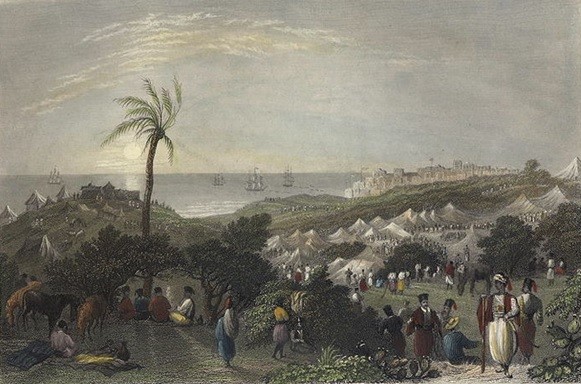
Cover image: Encampment of Ibrahim Pasha, near Jaffa. Print by W. H. Bartlett, from 1838
December 6, 1834 | © Manchester Courier
Archival material reproduced here for educational and research purposes under fair use. Original copyright belongs to the respective publisher.
About

Every headline has a history. We go back to the archives of the same media you read today — to show how their own words have changed. Facts don’t expire. Narratives do.
Featured Posts