We are only Palestinian for political reasons
Zoheir Mohsen trusts only Syria
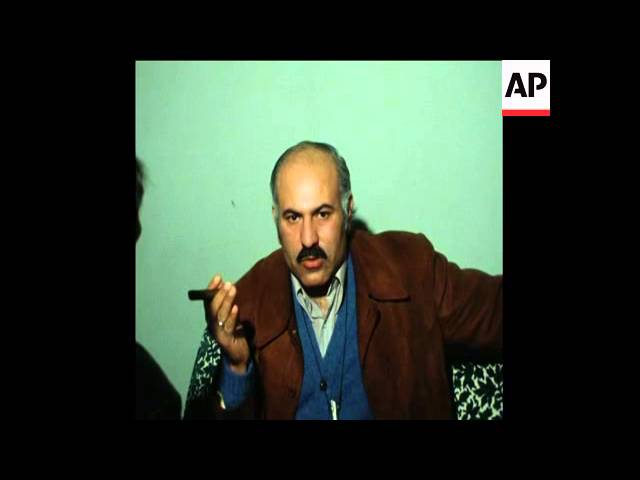
Mar 31, 1977
By James Dorsey
“He is our leader. Thousands like me believe in him,” says one of the five bodyguards of Zoheir Mohsen, leader of the pro-Syrian Palestinian guerrilla organization Al Saika. Mohsen, who is also head of the military operations department of the Palestinian Liberation Organization (PLO) and a member of the PLO's executive council, was in Cairo for the meeting of the Palestinian National Council.
Despite the loyalty of his followers and the important position he holds within the movement, “when I attend a meeting, no one can make a decision,” he reportedly did not feel entirely at home in Cairo. Mohsen was not warmly received by his Palestinian peers during the council sessions.
Mohsen and his Palestinian guerrilla fighters are politically aligned with the ruling Baath Party in Syria. Within the PLO, he defends Syrian interests. Many within the Palestinian resistance have not forgotten the events of the Lebanese civil war, when Syrian forces turned against the alliance of Palestinians and leftist Lebanese. There were frequent clashes between Al Saika and the largest Palestinian guerrilla group, Al Fatah. During the Lebanese civil war, rumors repeatedly emerged that the regime in Damascus wanted to replace PLO leader Yasser Arafat with Mohsen.
Aversion
Despite the apparent unity at the Palestinian congress, Saika and most other Palestinian groups this week made little effort to hide their aversion to Al Saika.
The tensions became most apparent immediately after the assassination of the leftist Lebanese leader Kamal Jumblatt, when the Fatah representative in Cairo, Ribhi Awad, declared that “the murderers are among us,” pointing his finger in the direction of Mohsen and his followers.
The root causes of the divisions within the Palestinian movement run much deeper than the war in Lebanon.Mohsen, in essence, aligns more closely with Baathist-flavored Arab nationalism — describing the supporters of the Palestinian Rejectionist Front as “romantics and fascists” — than with the ideological stance of, for example, Al Fatah.
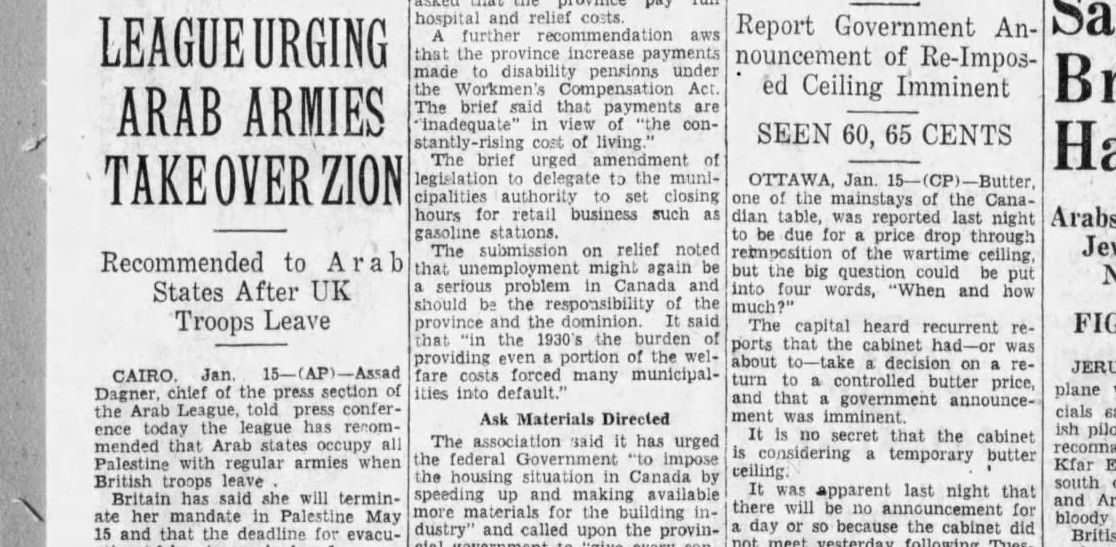
“We believe that the Palestinians must first and foremost cooperate with Syria, and only then with the other Arab states. Only Syria can play an effective role in the struggle against Israel. We cannot operate from Egypt. Syria is our most important base in order to continue the struggle against the Zionist invasion since 1918.”
No People
Mohsen’s stance is not very surprising. Listening to his political and ideological views, one sometimes cannot suppress the feeling that perhaps less has changed in the Arab world than was originally assumed. According to Mohsen, in fact there is no separate Palestinian people. Between Jordanians, Palestinians, Syrians and Lebanese there are no differences. We are part of one people: the Arab nation. Look, I have relatives with Palestinian, Lebanese, Jordanian and Syrian citizenship. We are one people. Only for political reasons do we carefully assert our Palestinian identity. It is of national interest for the Arabs to encourage the existence of the Palestinians in opposition to Zionism. Yes, the existence of a separate Palestinian identity is only for tactical reasons. The founding of a Palestinian state is a new means to continue the struggle against Israel and for Arab unity.
Mohsen’s logic is actually very simple: “Because Golda Meir says there is no Palestinian people, I say that there is indeed a Palestinian people, distinct from Jordan.”
Strategy
The strategy Mohsen wants to follow is also quite simple: “A separate Palestinian entity must assert the national rights in the still remaining occupied territories. The Jordanian government cannot speak on behalf of the Palestinians in Israel, Lebanon or Syria. Jordan is a state with defined borders. It cannot claim, for example, Haifa or Jaffa, while I do have a right to Haifa, Jaffa, Jerusalem and Beersheba. Jordan can only speak for the Jordanians and the Palestinians in Jordan. The Palestinian state would have the right to act on behalf of all Palestinians in the Arab world and elsewhere. Once we have acquired all our rights throughout Palestine, we must not delay for a moment the reunification of Jordan and Palestine.”
Agreement
Mohsen’s analysis of the function of the existence of a Palestinian people is not the only political agreement he has with the official Israeli position. One of the Israeli arguments for holding on to the territories occupied in 1967 is the concept of secure, defensible borders. Despite the fact that the Arab countries and the Palestinians repeatedly discard this concept in their propaganda war against Israel, it was precisely the idea of secure borders that was the core of Mohsen’s defense of the Syrian intervention in the Lebanese civil war. The Syrians intervened in Lebanon only to stop the hostilities. This was Syria’s sole intention, and it succeeded in being accepted by all parties in Lebanon as a mediator. Syria believed that Syrian security would be endangered by renewed war in Lebanon.
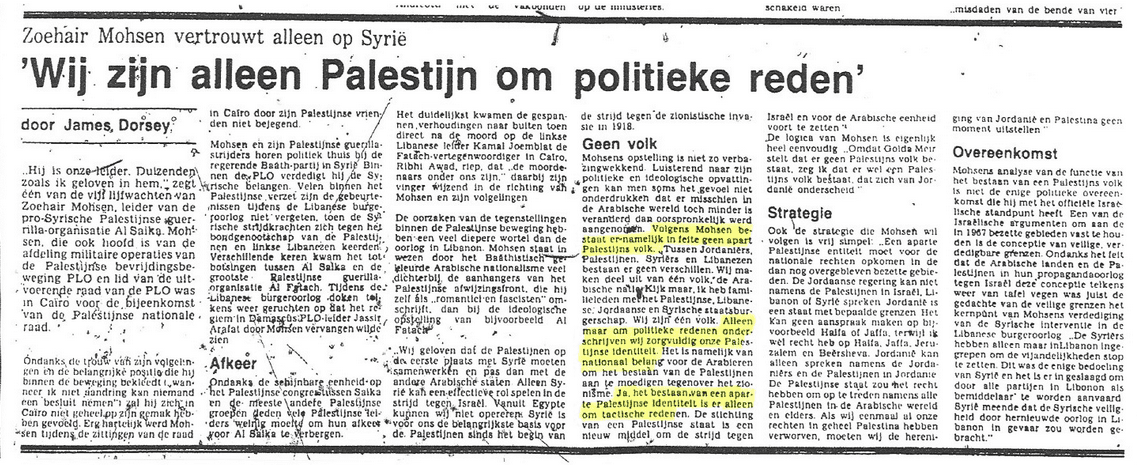
March 31, 1977 | © Trouw
Archival material reproduced here for educational and research purposes under fair use. Original copyright belongs to the respective publisher.
About

Every headline has a history. We go back to the archives of the same media you read today — to show how their own words have changed. Facts don’t expire. Narratives do.
Featured Posts