>
>
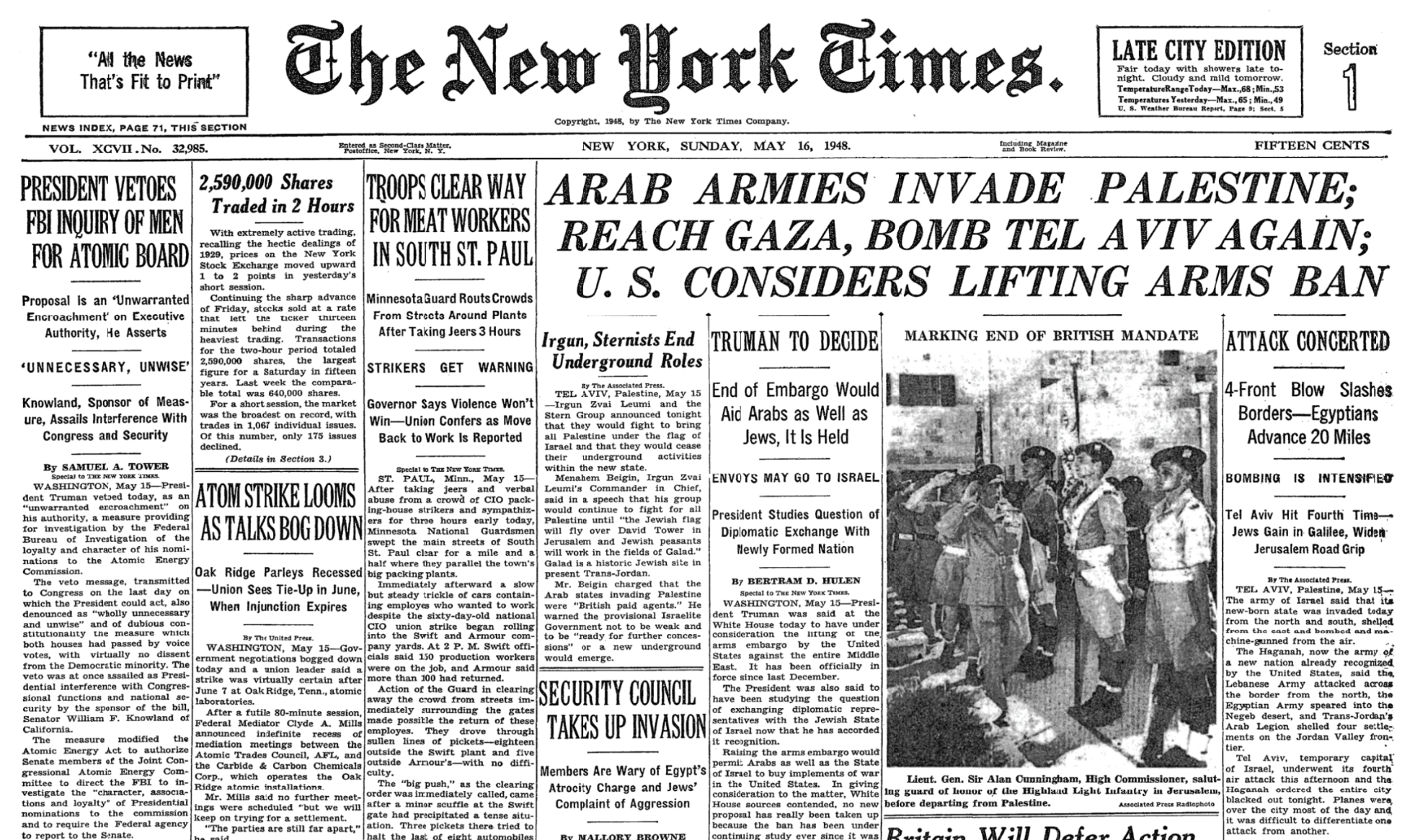
ARAB ARMIES INVADE PALESTINE; REACH GAZA, BOMB TEL AVIV AGAIN; U.S. CONSIDERS LIFTING ARMS BAN
ARAB ARMIES INVADE PALESTINE; REACH GAZA, BOMB TEL AVIV AGAIN; U.S. CONSIDERS LIFTING ARMS BAN
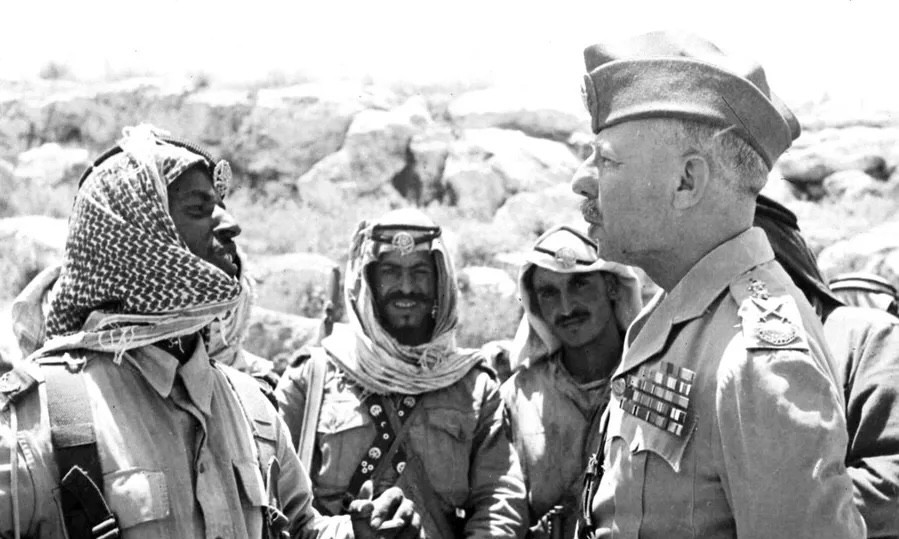
On the photo: John Bagot Glubb (right), commander of the Jordanian Arab Legion with Arab soldiers in July 1948.
ATTACK CONCERTED
4-Front Blow Slashes Borders — Egyptians Advance 20 Miles
Tel Aviv Hit Fourth Time—Jews Gain in Galilee, Widen Jerusalem Road Grip
By The Associated Press.
TEL AVIV, Palestine, May 15— The army of Israel said that its new-born state was invaded today from the north and south, shelled from the east and bombed and machine-gunned from the air.
The Haganah, now the army of a new nation already recognized by the United States, said the Lebanese Army attacked across the border from the north, the Egyptian Army speared into the Negeb desert, and Trans-Jordan’s Arab Legion shelled four settlements on the Jordan Valley frontier.
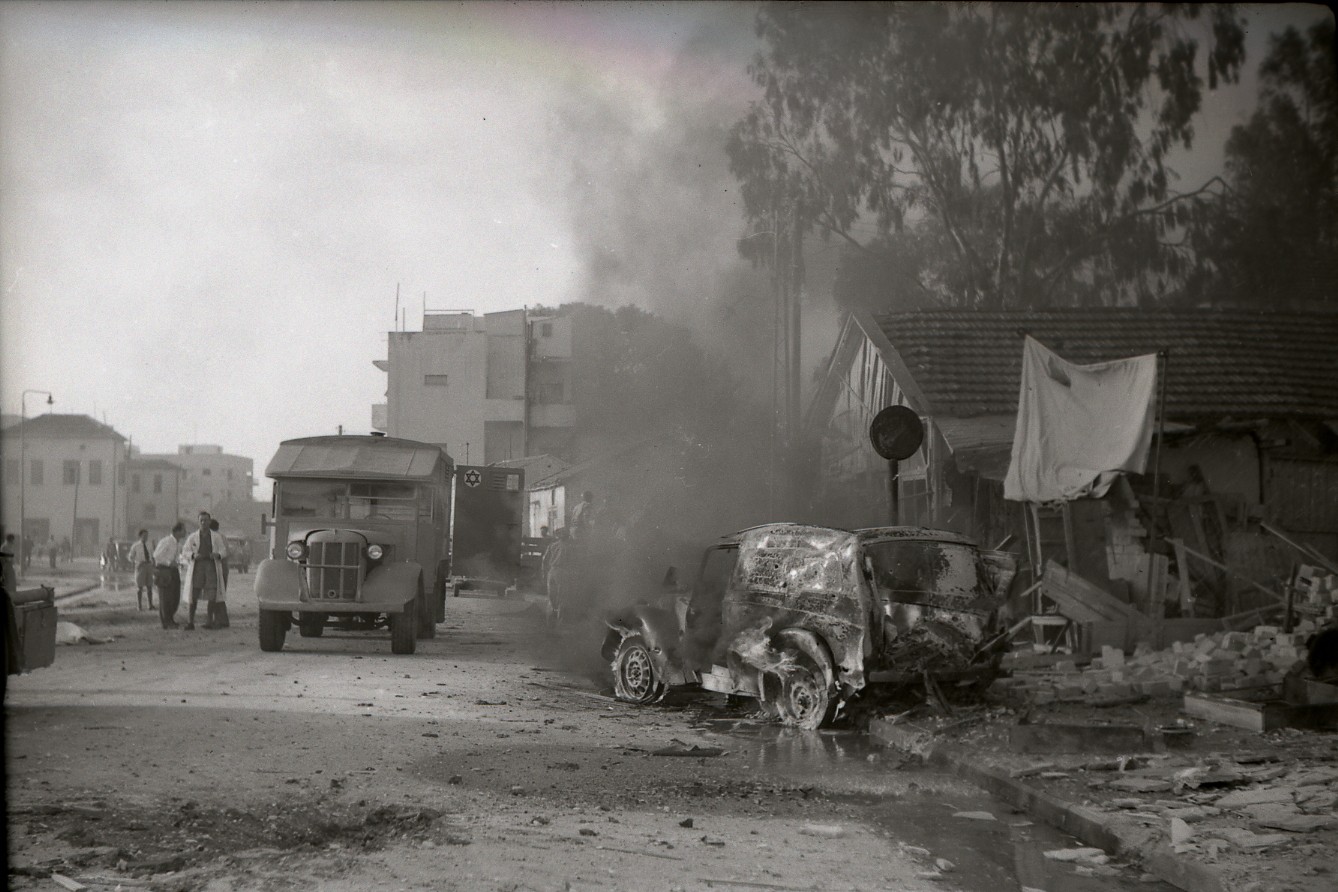
Tel Aviv, temporary capital of Israel, underwent its fourth air attack this afternoon and the Haganah ordered the entire city blacked out tonight. Planes were over the city most of the day and it was difficult to differentiate one attack from another.
Plane, Pilot Captured
Two bombing and strafing attacks this morning killed one person and injured six. The Haganah said that one of the attacking planes—a Spitfire—"fell into our hands and we captured its Egyptian pilot." A half dozen bombs fell at the edge of the Tel Aviv airport near the power and light building.
All the attacks were on the outskirts. They did not interfere much with Jews celebrating the first Sabbath in almost 2,000 years on soil they claimed as their very own.
The Egyptian army said two columns of troops invaded southern Palestine and that one destroyed the Jewish settlement of Al Dangor, thirteen miles southeast of Gaza. [This would be in the territory of Israel, as defined in the United Nations decision on partition.]
[The Egyptian Defense Ministry in Cairo said the vanguard of regular Egyptian troops reached Gaza Saturday night, while Egyptian volunteers occupied the hills of Ali Mintar on Gaza’s outskirts. Gaza is a Mediterranean port town, twenty miles inside Palestine and situated on the main coastal railroad.
[The Iraqi Government announced in Baghdad that its Army had entered Palestine.]
A dispatch from Beirut said the Lebanese troops had captured Malikya, a town one mile inside Israel on the northern frontier.
Air Attacks in North
Advance patrols of the Syrian army seized a small bridge over the Jordan River and knifed into the area south of the Sea of Galilee, also inside Israel territory on the east, a dispatch from Damascus said.
Farther south King Abdullah’s Trans-Jordan Arab Legion crossed the Allenby Bridge, occupied Jericho, and took military control of a large area in the Judean hills, twenty miles northeast of Jerusalem, advices from Jericho said.
Foreign planes, not officially identified, also attacked the northern and southern sections of the Jewish state, the Haganah said.
Spitfires hit settlements in the Samakh district on the southeastern shore of Lake Tiberias (Galilee) near the junction of the Syrian and Trans-Jordan borders, the Haganah said.
Arab Legion artillery smashed at four settlements in this same area, Ein Gev on the eastern shore of Tiberias and Ashdot Yaacov, Shaar Hagolan and Gesher farther south, the Haganah broadcast said. All these places are in Jewish Palestine as delineated by the United Nations.
Late advices to Haganah sources in Haifa said the attacks were repulsed. These sources also said the Jews took several Arab villages on the slopes of Mount Carmel and near Afula.
The legion was said to have captured a power plant near Naharayim, a town which is in Trans-Jordan.
Other air attacks were made on the airdrome near Rehovoth south of Tel Aviv in Israel and leaflets demanding surrender were dropped on Urim, a settlement in the Negeb, ten miles from the Egyptian border.
The Haganah said that two western settlements were under heavy attack by the Egyptians. These were Nirim, only four miles inside the Palestine frontier, and Kfar Darom, which lies ten miles from the frontier along the main highway to Gaza.
The Haganah said the attack on Nirim, with tanks and shell fire, was by regular forces of the Egyptian Army. Both Nirim and Kfar Darom lie just outside the borders of the new state as defined in the United Nations plan for partition.
In the far north the Haganah said it occupied the tiny Arab village of Malikya about a mile from the Lebanese border inside Israel, but that regular units of the Lebanese Army were counter-attacking there this afternoon.
Jewish sources in Haifa said the Haganah troops were also in control of Ras En Naqura, a northern frontier post on the west coast. These troops were reported driving north to consolidate the western area against a Lebanese invasion. Acre, first keypoint north of Haifa, sued for peace after a sharp night battle, the informants said.
Haganah broadcasts said also that the Arab Legion south of Jerusalem was attacking Masot Yitzhak, a settlement just north of Kfar Etzion, which the Haganah said the Arab Legion had wiped out. Revadin and Ein Zurim, two other nearby settlements, were probably already in Legion hands, the Haganah added.
The Jewish settlement of Attarot opposite Kalandia airport, north of Jerusalem was evacuated after Arab Legion attacks, the Haganah said.
The Haganah warned the Arabs to respect the Geneva convention for treatment of war prisoners, saying that the Jews also held many Arab prisoners.
In Jerusalem itself the British Army announced that it had completed the evacuation of all its forces. The Haganah said its troops were taking over British installations as soon as the British stepped out. The United Nations consular commission continued to negotiate for a truce in the Holy City.
The new state imposed a military censorship as it marshalled all its strength against the surrounding Arab armies.
May 16, 1948 | © The New York Times
Archival material reproduced here for educational and research purposes under fair use. Original copyright belongs to the respective publisher.
About

Every headline has a history. We go back to the archives of the same media you read today — to show how their own words have changed. Facts don’t expire. Narratives do.
Featured Posts