Arabs Still Crossing Frontier To Get Hadassah Medical Aid
Even Guerrilla Fighters Are Treated at Advanced Jerusalem Hospital, Where '67 War Has Brought Many Changes
JERUSALEM, Jan. 25 — One of the best-kept secrets of the nearly two decades of armed truce between Israel and Jordan that exploded into war in 1967 was the treatment by Israeli doctors of prominent Arab patients.
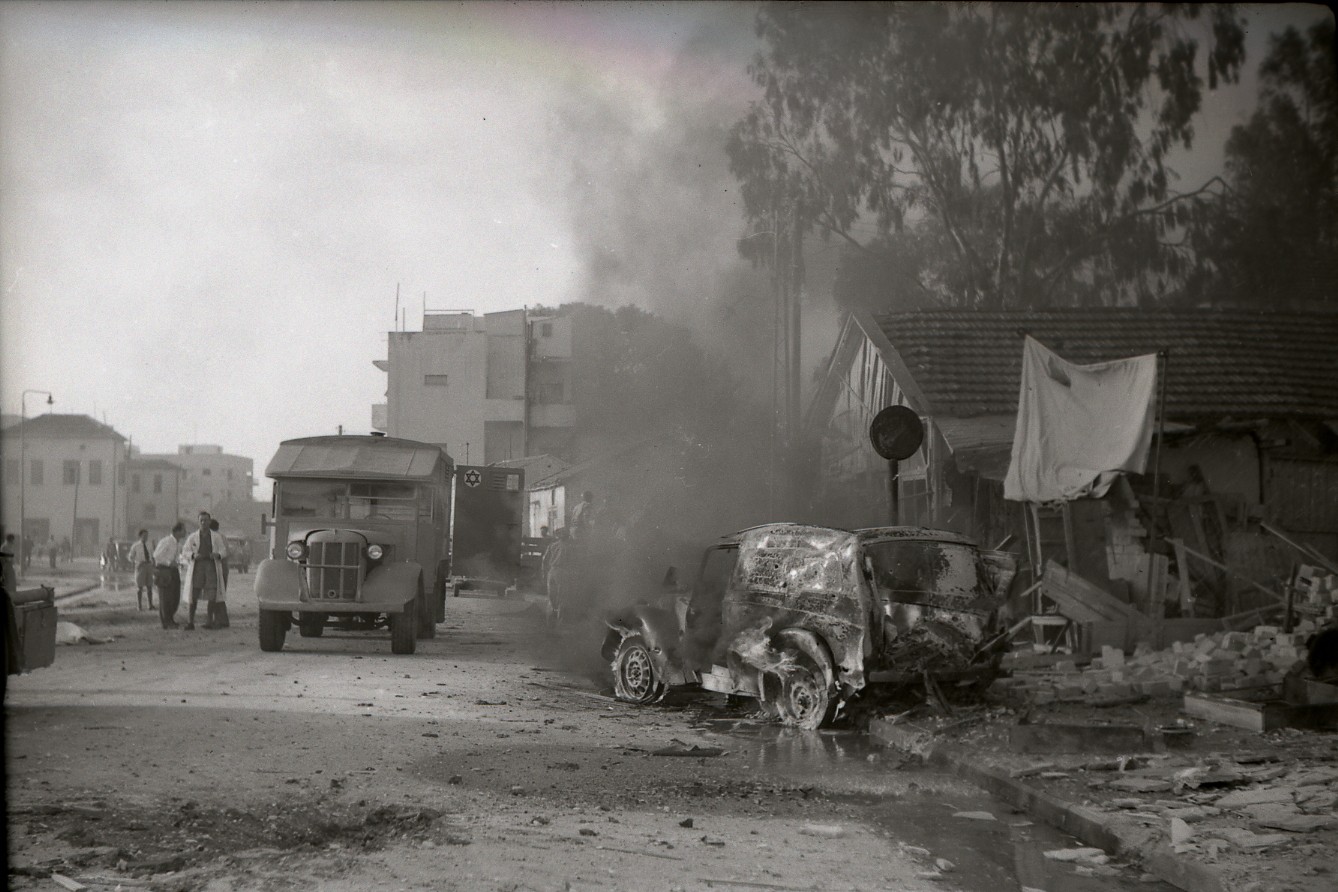
The Arabs would cross the Mandelbaum Gate transit point in Jerusalem, sometimes after having been transferred in no-man's land from an ambulance of the Red Crescent to one of the Red Star of David.
The patients would be treated in almost even instance at the Hebrew University-Hadassah Medical Center, probably the most advanced such institution in the Middle East, and would then return to Jordan just as quietly.
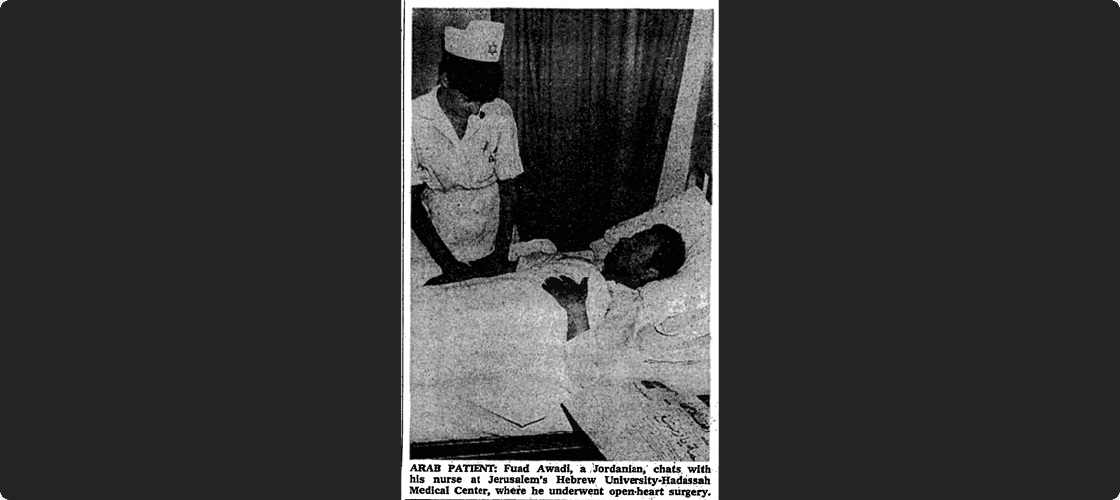
A reminder that this unusual medical traffic still exists across an even more actively hostile frontier came last week when a 42-year-old resident of Irbid in Jordan left Hadassah after open heart surgery.
Many Get Treatment Now
The patient, Fuad Awadi, is a clerk in a taxi office. He required hospitalization while visiting his family in Kafr Kanna, a town held in 1948 when it came under Israeli control.
Prominent Arab patients still come to Hadassah but the open-border policy instituted by Jordan and Israel across their cease-fire line after the six-day war in June, 1967, means that any of the hundreds of ordinary Arabs who cross each week can get the treatment once open only to the influential.
The Israeli hospital has also treated nearly 50 Arab guerillas, most of them members of Al Fatah, in the many months of Arab commando activity since the war.
"They're really a nuisance," Dr. Kalmann Mann, the director of the hospital, said in a recent interview. "They end up in the best rooms because they come in with policemen to guard them and they need the extra space."
Arguments have often ensued between the guerillas and Israeli patients who do not regard the Arab patients with the equanimity of the hospital staff. Dr. Mann also described some other ways in which the war and the Israeli occupation of the west-bank area of Jordan has altered the medical center's operations.
"Even before the war was over we began to get Arab patients in here. Some had undergone treatment at our Mount Scopus hospital before 1948 and now they were coming back."
Mount Scopus became an inaccessible and armed Israeli enclave in Jordanian Jerusalem after the 1948 war; a new structure was built in Israeli Jerusalem. The original hospital will be reopened next year, essentially for Arab patients.
Hostility Becomes Problem
The mutual hostility that developed since 1948 became something of a problem between Jews and Arabs at Hadassah when the 1967 war ended and they were exposed to each other.
"That first week in June we were taking in Arab soldiers and some of our nurses began to object," Dr. Mann said. "We had a little talk in my office and since then it has been all right."
"I told them that we have to treat them, as individuals, not as the enemy, and I told them of my own experience in World War II treating German prisoners in Southhampton, England," he added.
As for noncombatants, Dr. Mann said the hospital handles an average of 35 outpatients from towns in occupied Arab areas each day and an average of 10 bed patients from these areas each month.
Some Seek 'Last Chance'
Many Arabs patients arriving at Hadassah immediately after the war were seeking cures for long-neglected ailments, such as skin diseases, and were seeking "one last chance" on major illnesses.
Last month Hadassah signed an agreement with the United Nations Relief and Works Agency to treat refugee heart and cancer patients. Every day now ambulances bring the patients from among the approximately half-million refugees under Israeli control.
Most refugee cases are treated by the Augusta Victoria Hospital atop the Mount of Olives, which is run by the Lutheran World Federation. Hadassah and Augusta Victoria medical officials meet weekly to determine which cases are to be treated at Hadassah.
The United Nations agency pays Hadassah just under $2 for each heart patient, which Dr. Mann says is a token, and nothing for the cancer cases. The agency was reported by Hadassah to have said that the Jordanian Government had a similar agreement with the United Nations, although heart cases are sent to Cairo and Beirut for treatment.
Medical costs are far in excess of the fees that Arab patients are able to pay, Dr. Mann said. This would indicate that contributors would have to continue to support the broadened services.
No Urgent Case Rejected
A bed costs about $30 a day, Dr. Mann said, but the hospital tries to get at least $9 from each patient. No urgent case is turned away, however, he added.
Israel's sick fund pays about that amount, but only 10 per cent of the Arabs living in East Jerusalem, which has been absorbed by Israel, are covered by this plan. West-bank and Gaza Strip residents have no such medical coverage.
Indigent cases are worth $2.70 from the Municipality of Jerusalem, Dr. Mann said, so Hadassah asks west-bank Arabs who are not working to pay that much, although few do. "One third of our cancer radiation cases are Arabs," the doctor said. "It's quite a problem."
January 27, 1969 | © The New York Times
Archival material reproduced here for educational and research purposes under fair use. Original copyright belongs to the respective publisher.
About

Every headline has a history. We go back to the archives of the same media you read today — to show how their own words have changed. Facts don’t expire. Narratives do.
Featured Posts