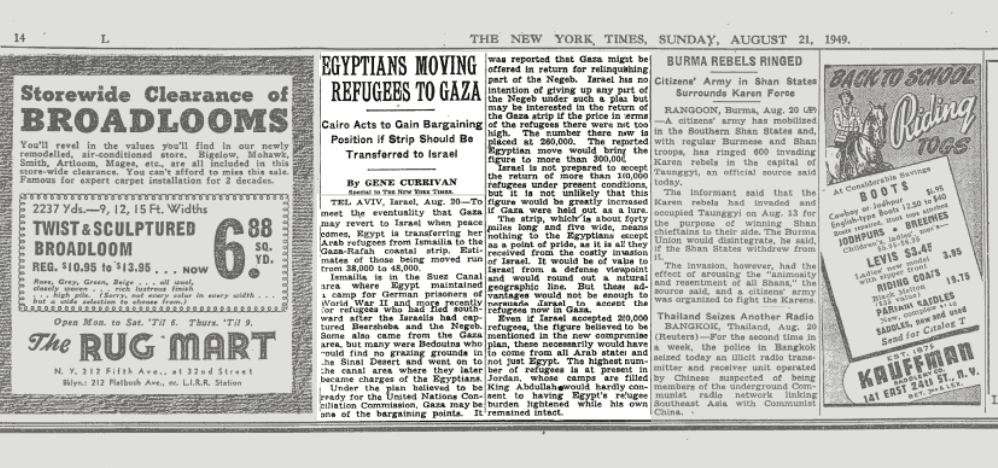
EGYPTIANS MOVING REFUGEES TO GAZA
Cairo Acts to Gain Bargaining Position if Strip Should Be Transferred to Israel
By GENE CURRIVAN Special to THE NEW YORK TIMES.
TEL AVIV, Israel, Aug. 20– To meet the eventuality that Gaza may revert to Israel when peace comes, Egypt is transferring her Arab refugees from Ismailia to the Gaza-Rafah coastal strip. Estimates of those being moved run from 38,000 to 48,000.
Ismailia is in the Suez Canal area where Egypt maintained a camp for German prisoners of World War II and more recently for refugees who had fled southward after the Israelis had captured Beersheba and the Negeb. Some also came from the Gaza area, but many were Bedouins who could find no grazing grounds in the Sinai Desert and went on to the canal area where they later became charges of the Egyptians.
Under the plan believed to be ready for the United Nations Conciliation Commission, Gaza may be one of the bargaining points. It was reported that Gaza might be offered in return for relinquishing part of the Negeb. Israel has no intention of giving up any part of the Negeb under such a plan but may be interested in the return of the Gaza strip if the price in terms of the refugees there were not too high. The number there now is placed at 260,000. The reported Egyptian move would bring the figure to more than 300,000.
Israel is not prepared to accept the return of more than 100,000 refugees under present conditions, but it is not unlikely that this figure would be greatly increased if Gaza were held out as a lure.
The strip, which is about forty miles long and five wide, means nothing to the Egyptians except as a point of pride, as it is all they received from the costly invasion of Israel. It would be of value to Israel from a defense viewpoint and would round out a natural geographic line. But these advantages would not be enough to persuade Israel to accept the refugees now in Gaza.
Even if Israel accepted 250,000 refugees, the figure believed to be mentioned in the new compromise plan, these necessarily would have to come from all Arab states and not just Egypt. The highest number of refugees is at present in Jordan, whose camps are filled. King Abdullah would hardly consent to having Egypt’s refugee burden lightened while his own remained intact.

August 21, 1949 | © The New York Times
Archival material reproduced here for educational and research purposes under fair use. Original copyright belongs to the respective publisher.
About

Every headline has a history. We go back to the archives of the same media you read today — to show how their own words have changed. Facts don’t expire. Narratives do.
Featured Posts